Why 90 BPM is 180 steps a minute
Runners take two steps per beat without noticing. That is why a 90 BPM track feels like it was made for a 180 cadence, why a 165 BPM track can quietly pull your stride down, and why the number on your playlist is worth checking.
Updated 25 September 2026

Two steps per beat
Put on a 90 BPM track and run. Within a minute one foot is landing on every beat and the other exactly between beats. You are at 180 steps a minute and you did not decide to be. Music entrains stride the way it entrains a room, and the ratio it picks is almost always 2:1 for anything under 120 BPM and 1:1 for anything over 150.
Cadence to tempo
| Cadence | Effort | Half-time music | Direct music |
|---|---|---|---|
| 160 spm | Easy / recovery, taller runners | 80 BPM | 160 BPM |
| 165 spm | Easy | 82–83 BPM | 165 BPM |
| 170 spm | Steady | 85 BPM | 170 BPM (most DnB) |
| 175 spm | Steady / tempo | 87–88 BPM | 175 BPM |
| 180 spm | Tempo, the textbook target | 90 BPM | 180 BPM |
| 185 spm | Intervals, shorter runners | 92–93 BPM | 185 BPM |
| 190 spm | Fast intervals | 95 BPM | 190 BPM |
180 is a reference, not a law
The number comes from Jack Daniels counting elite strides at the 1984 Olympics and noticing almost nobody was under 180. Elite runners at race pace, in other words. A recreational runner at an easy pace is usually somewhere between 160 and 175, and taller runners sit lower. Forcing 180 on day one shortens the stride without fixing the mechanics that make it long.
The useful move is smaller: find your current cadence, raise it by about five percent, and build music that supports that number. The table above gives you both octaves for every target, so you can stay in the genres you actually like.
What your playlist really runs at
Apple Music does not expose BPM. Spotify's value, where it exists, is a catalogue estimate that is often at the wrong octave and wrong outright for edits. So most cadence playlists are built on guesses, and a 165 BPM track in a 180 set is the reason the last two kilometres felt off.
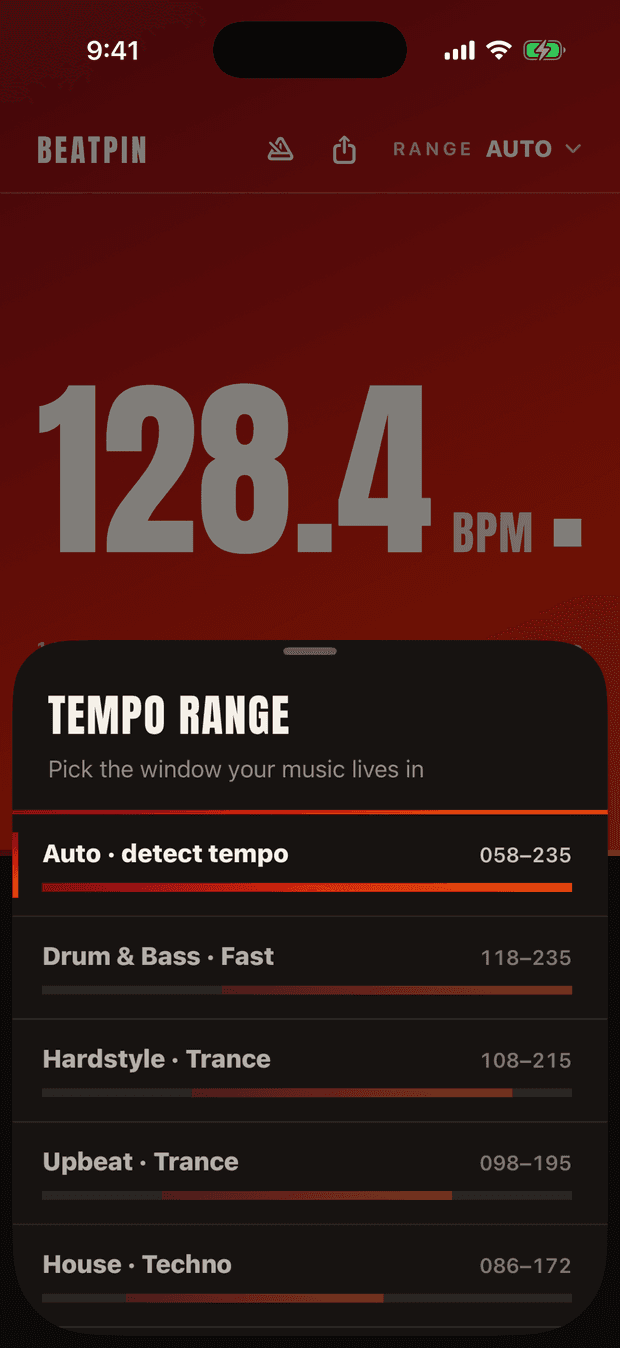
The fix is to measure. Play the track on any speaker, point the phone at it, and read the lock. Beatpin's Cardio · Run range folds slow tracks up to the step rate, so a 90 BPM song reads as 180 directly, and the ½ and 2× chips beside the number make the other octave a glance rather than a calculation. The live BPM guide covers when to trust the reading.
Building a cadence playlist
- Measure your current cadence on an easy run (watch, or count one foot for 30 seconds and multiply by four).
- Pick a target five percent higher and find its row above.
- Read your candidate tracks live and keep the ones within ±2 BPM of either column.
- Put the awkward 120–150 BPM tracks in the warm-up and cool-down, where cadence does not matter.
What are you actually running to?
Play your playlist on a speaker, point the phone at it, and Beatpin shows the tempo with its double beside it. Cardio · Run reads 90 as the 180 you run. Free, no ads.